James Titus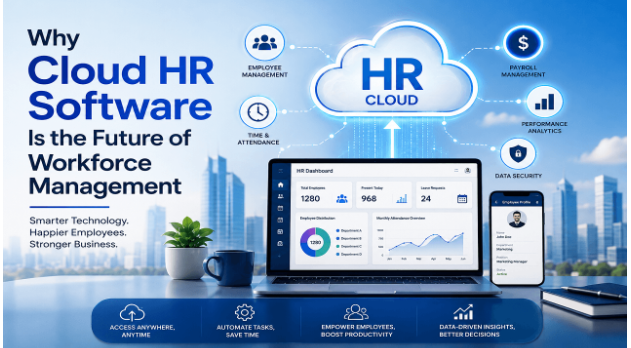
What actually changed in HR over the last five years? Not the job. HR professionals still hire, still pay people, still keep the company out of legal trouble. What changed is where the work happens. Teams got scattered across cities and time zones.
Approvals started happening on phones instead of desks. Moreover, systems that live on a single office server suddenly became the weakest link in an otherwise flexible organization. That shift — quiet but permanent — is why cloud HR software went from “nice upgrade” to “how are you still not on this?”
So let us talk about what that actually means for your business — the money, the data, the compliance headaches, and why this shift matters more right now than it did even two years ago.
What Cloud HR Software Actually Covers
People use HR software, HRIS software, and HRM software almost interchangeably, but they solve different problems. HRIS software is your system of record — employee data, documents, org structure, history. HRM software layers on people management: performance reviews, goals, training, succession. Payroll software handles money — salary processing, deductions, statutory filings.
In the old setup, these were three separate systems, with someone manually reconciling them at month-end. Cloud platforms put them on a single database. When a salary changes, payroll knows immediately. When someone resigns, system access is revoked automatically. When a manager approves leave, the attendance record and payroll calculation both update.
That is the real difference — not that it is online, but that the pieces finally talk to each other.
The Cost Math
On-premise HR software carries costs that never appear on the invoice: server hardware, an IT person who understands the system, paid upgrades every few years, and custom development every time you connect a new tool.
Cloud shifts this to a per-employee subscription. Predictable, and the vendor absorbs maintenance, security patching, and version upgrades.
This matters most for mid-sized companies. At 200 employees, you probably can’t justify a dedicated HR systems administrator — but you still need capability that used to require one. Cloud closes that gap.
It is also why adoption of HR software in Bangladesh has moved fast. Vendors offering HRM software in Bangladesh and payroll software in Bangladesh can now deliver functionality that previously demanded serious in-house IT investment — which changes the calculation for growing companies operating on tight margins.
Your Data Starts Answering Questions
Most HR teams have plenty of data. Few can actually use it, because it lives in separate files that nobody joins together.
Once everything sits in one system, real questions become answerable:
- Which departments lose people fastest, and at what tenure?
- Are there pay gaps between employees doing the same work?
- Which hiring sources produce people who stay past two years?
- Where exactly do approvals stall, and for how long?
None of this requires AI. It requires one clean dataset. That shift — from opinion to evidence — is what gets HR taken seriously in budget conversations.
Self-Service Removes the Biggest Time Drain
Ask an HR executive where their week goes, and you will rarely hear “strategy.” You will hear repeated questions: what is my leave balance, where is my payslip, how do I update my bank details, can I get a salary certificate.
Every one of those is answerable by the employee themselves in a decent cloud system. Payslips download on demand. Leave balances show live. Address changes flow straight into payroll without a form.
The time saved is significant, but the trust matters more. When people can see their own data, they stop assuming errors are being hidden from them.
Security and Compliance
The common objection is whether employee data is safe off-site. Fair question — but compare honestly. A cloud vendor runs dedicated security staff, scheduled audits, encryption at rest and in transit, access logging, and certifications like SOC 2 or ISO 27001. Most in-house server rooms have none of that, and access control often means “whoever knows the password.”
Compliance is the more practical win. Labour law changes. Tax structures get revised. Statutory filing formats update. With on-premise software, someone has to notice and then pay for the change. Good cloud payroll software pushes the update to every customer at once. For companies running HRM software in Bangladesh, that means labour law and tax handling stays current without your team tracking gazette notifications themselves.
Built for Distributed Teams
Work stopped being tied to a building. Employees join from different cities, managers approve from phones, and new hires sometimes complete onboarding without visiting an office.
Cloud HR software handles this because access is not location-dependent. Attendance, leave, payslips, performance check-ins — the same experience wherever someone sits. On-premise systems need VPNs and workarounds that quietly discourage people from using them at all, which is how shadow spreadsheets get born.
Integration Is Where Cloud Quietly Wins
HR software rarely works alone. Attendance devices, accounting systems, recruitment tools, and banking portals all need to exchange data. On-premise setups handle this through custom development — expensive to build, fragile to maintain, and broken again every time one side upgrades.
Cloud platforms expose APIs as standard. Biometric punches sync automatically. Payroll journals post to accounting without re-entry. Disbursement files export in the format your bank actually accepts.
This matters most for manufacturing and RMG companies running shift-based teams across multiple units, where attendance volume alone makes manual reconciliation unworkable. Integration is not a feature you notice daily — it is the one whose absence you notice every month-end.
What Switching Actually Involves
Migration is the real fear, not the software. Three things worth knowing before you start:
Data cleanup takes longer than setup: Most of the timeline is fixing inconsistent employee records, not configuring the platform. Start there.
Run parallel for one or two payroll cycles: Process payroll both the old way and the new way, compare outputs, then cut over. It costs a few extra days and prevents the disaster scenario.
Adoption depends on managers, not HR: If managers approve inside the system, everyone uses it. If managers keep approving over WhatsApp, the rollout fails regardless of the software.
When evaluating vendors, ask specifically about local statutory compliance, data export in usable formats, and support response times. For HRIS software in Bangladesh, verify how the system handles local labour law requirements and tax structures before signing anything.
The Bottom Line
Cloud HR software is not valuable because it is modern. It is valuable because it removes the manual reconciliation, delayed approvals, and unreliable data that quietly cost time and trust every month.
The practical gains: predictable cost, one source of truth, self-updating compliance, and access that does not depend on where someone is sitting.
If one person in your company holds critical system knowledge, if payroll needs manual cross-checking every cycle, or if you can’t answer basic workforce questions without a week of digging — that’s your signal. The technology to fix it has existed for years. The only real question left is which platform, and when.